
T: +86-18066442232
E: sylvia@wzhongshuojixie.com
E: sylvia@wzhongshuojixie.com
Wanquan Industrial Zone, west of National Road 104, Sunlou Village, Wanquan Town, Pingyang County, Wenzhou City, Zhejiang Province
Views: 0 Author: Site Editor Publish Time: 2025-11-21 Origin: Site


Scaling from small-batch operations to full-scale manufacturing is not only a milestone but also a major test of consistency, efficiency, and investment readiness. For producers of eco-friendly drinking straws, moving from pilot runs to industrial capacity requires more than just faster output — it demands a system built for precision, repeatability, and compliance. At Wenzhou Hongshuo Machinery Co., Ltd., we help manufacturers turn scaling into a smooth, data-driven process through our comprehensive paper straw machine solutions, designed to match every stage of growth. Our expertise ensures that whether you are producing for local cafés or global beverage brands, your operation will meet strict hygiene and performance standards while remaining cost-effective.
Before investing in new production lines, manufacturers must define what “scaling” truly means for their operations. Is the goal to meet local café demand or to supply international distributors? Are you focusing on standard diameters like 6mm straws or expanding into jumbo and cocktail sizes? These questions guide how you should structure your capacity and product mix.
A well-defined capacity plan avoids overinvestment while ensuring the flexibility to adapt to future trends. Small producers often start with semi-automatic setups producing several thousand straws per hour, while large-scale facilities can reach hundreds of thousands. The right choice of machine depends on your targeted SKU range (color, pattern, length, and diameter), as each configuration influences the machine’s throughput and the speed-to-quality balance.
By understanding your market’s volume requirements and product diversity, you can accurately match machine features, automation level, and auxiliary equipment to production targets. Many customers of Wenzhou Hongshuo Machinery begin with compact models and then expand to multi-head automatic lines once steady demand is established, proving that a staged approach offers both flexibility and financial control.
As businesses scale, they face a common decision: whether to upgrade an existing small-scale line or invest directly in high-speed automation. Both have advantages depending on your growth strategy and budget.
Starter paper straw machines are ideal for pilot production, custom orders, or testing new paper types and adhesives. These models emphasize flexibility, smaller footprints, and lower power consumption. However, manual handling and limited automation mean higher labor costs and longer cycle times.
High-speed automatic paper straw lines, on the other hand, represent the future of volume manufacturing. They integrate precision winding systems, servo-driven controls, and synchronized cutting mechanisms to ensure each straw meets strict dimensional standards. Wenzhou Hongshuo Machinery’s high-speed lines can seamlessly handle glue-free or glued straw production, offering clean joins and smooth surfaces at industrial pace.
Choosing between these tiers isn’t just about output numbers — it’s about operational philosophy. If your market demands frequent size changes or seasonal designs, modular starter lines provide agility. If your priority is large, consistent batches, automation ensures consistent quality and minimal waste. In both cases, scalability is built into our designs, so upgrading from a starter unit to a full-scale line can be achieved without replacing the entire system.
Scaling isn’t achieved by a single paper straw machine — it’s realized through integration. When a facility expands, it must align primary and ancillary equipment to maintain flow and reduce downtime.
Essential components around the straw-making process include paper slitters (for precise roll preparation), straw cutters, stackers, and packaging machines. Proper synchronization between these systems ensures balanced throughput. For example, a mismatch between straw production and packaging speed can create bottlenecks or material wastage.
Wenzhou Hongshuo Machinery provides complete integration solutions that link each stage — from slitting to packing — under centralized control systems. This eliminates manual handling errors and supports smooth scaling without constant recalibration. Moreover, our machines are designed with CE and SGS certifications, guaranteeing compliance with international safety and hygiene standards — critical factors for exporting eco-friendly straws.
To help clients achieve continuous operation, we also provide design consultations for factory layout, workflow optimization, and maintenance scheduling. This systems-level perspective allows manufacturers to think beyond individual machines and build a sustainable production ecosystem.
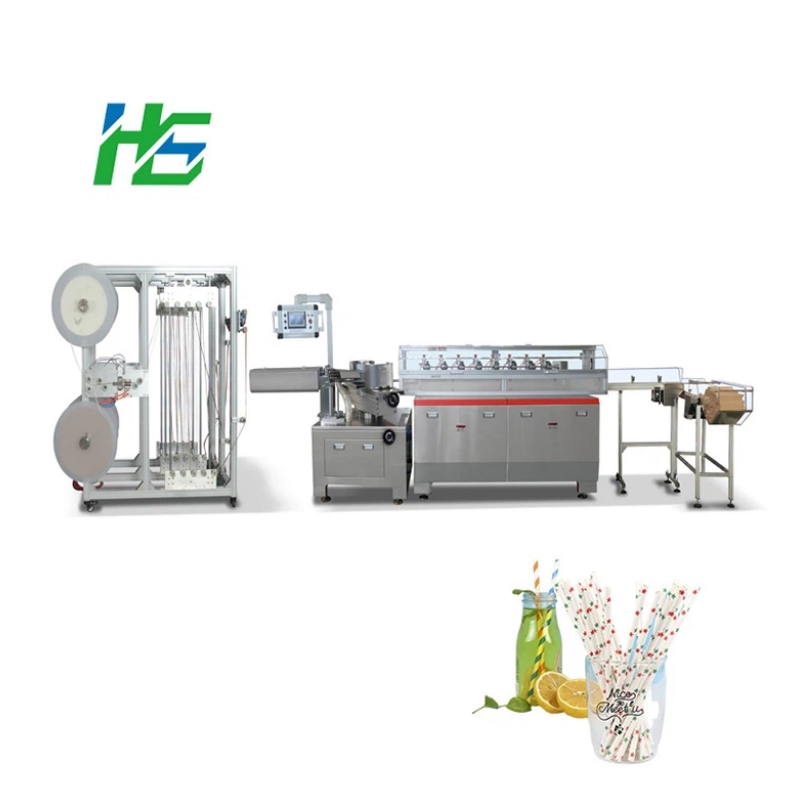
As output grows, maintaining product consistency becomes one of the biggest operational challenges. When thousands of straws are produced per hour, even a minor alignment or temperature variation can affect bonding and diameter accuracy.
Automation is the key to repeatability. Modern paper straw machines use servo motors for precision winding, automatic tension adjustment for even gluing, and digital calibration systems that store production recipes. This allows operators to recall exact configurations for each product type, minimizing setup time and human error.
In addition, optical inspection sensors can detect surface defects or misalignments early in the process, ensuring that every batch meets food-grade and visual standards. By investing in quality assurance features at the machine level, you reduce post-production inspection time and material waste — two silent costs that affect profit margins during scaling.
Reliable quality control not only enhances customer satisfaction but also strengthens your brand reputation in competitive global markets, where sustainability and consistency are equally valued.
Operational Excellence Efficiency (OEE) is the benchmark for sustainable scale. It combines availability, performance, and quality into one metric that reflects real productivity. During the scale-up phase, tracking downtime causes and output ratios helps identify where your facility loses time or materials.
Paper straw producers can implement continuous improvement by collecting daily OEE data directly from machine interfaces. Wenzhou Hongshuo Machinery’s systems are equipped with smart PLCs and remote monitoring options, enabling operators to visualize performance trends and schedule predictive maintenance.
Downtime analysis reveals valuable insights — whether it’s a result of paper feeding inconsistency, cutter misalignment, or temperature fluctuations in the drying section. By resolving these issues systematically, manufacturers can maintain consistent uptime even as capacity expands. Over time, these improvements translate into measurable cost savings, higher reliability, and improved sustainability metrics.
Scaling doesn’t always mean buying an entirely new production line. Smart manufacturers adopt phased investment strategies, starting with a mid-speed line and upgrading through modular components as orders grow.
Leasing and retrofit options can help preserve cash flow while expanding production gradually. Wenzhou Hongshuo Machinery supports such staged development with machine upgrade paths — allowing clients to add automation modules, new winding heads, or high-efficiency cutters as they expand.
A phased strategy also gives time for staff training, process stabilization, and customer base expansion, ensuring that every stage of growth is financially sustainable and technically secure. It’s a smarter, lower-risk approach to building a long-term business model around responsible manufacturing.
When scaling up, after-sales support becomes as important as the equipment itself. Even short downtimes can disrupt order delivery and customer satisfaction. Reliable access to spare parts, technical assistance, and training is essential for maintaining momentum.
At Wenzhou Hongshuo Machinery, we provide global customers with responsive support, CE- and SGS-certified spare parts, and on-site or remote troubleshooting. Our extensive experience in machinery R&D and commissioning ensures that every line upgrade or maintenance activity is handled smoothly. This commitment to customer success transforms the scaling process from a risk into a reliable growth opportunity.
Furthermore, we maintain long-term relationships with clients, offering upgrade advice, spare part replacement plans, and training programs for machine operators and technicians. Our goal is not only to sell machinery but to build production partnerships that evolve as your business grows.
Scaling paper straw manufacturing requires structured planning, advanced automation, and dependable technical support. Whether you are moving from pilot production to industrial capacity or expanding your current plant, Wenzhou Hongshuo Machinery’s solutions deliver reliability, efficiency, and compliance. Each paper straw machine we design serves as a building block toward higher output and long-term profitability. To explore capacity audits, system upgrades, or integration solutions, contact Wenzhou Hongshuo Machinery today and let us guide you toward your next phase of production excellence.
1. How can I estimate the right production capacity before investing in a new paper straw line?
Start by analyzing your current sales volume, market forecasts, and customer delivery requirements. This helps determine your ideal output per hour and guides the selection of a machine with suitable speed and automation level.
2. What’s the difference between a glue-free and glued straw production system?
Glue-free systems use eco-adhesive or heat-bonding technologies to join paper layers, offering enhanced sustainability and food safety. Glued systems remain versatile and suitable for certain product types or regions with specific regulatory standards.
3. How does automation affect paper straw quality at high volume?
Automation ensures consistent winding tension, uniform glue application, and precise cutting — all critical for maintaining diameter accuracy and smooth surfaces across large batches.
4. Does Wenzhou Hongshuo Machinery offer customized scaling solutions?
Yes. We design tailored solutions that match each client’s production scale, from entry-level models to fully automated high-speed lines, including integrated slitting and packaging systems for seamless operation.


