
T: +86-18066442232
E: sylvia@wzhongshuojixie.com
E: sylvia@wzhongshuojixie.com
Wanquan Industrial Zone, west of National Road 104, Sunlou Village, Wanquan Town, Pingyang County, Wenzhou City, Zhejiang Province
Views: 0 Author: Site Editor Publish Time: 2026-05-18 Origin: Site


The global phase-out of single-use plastics has forced manufacturers to transition to paper-based alternatives. This regulatory shift drastically changes the industrial focus. We no longer ask if we must implement sustainable production. Instead, we ask how we can execute it profitably. Scaling paper stick production introduces new operational complexities on the factory floor. Specifically, managers face daily challenges around structural integrity. They must ensure reliable hardness and manage delicate winding precision. Downstream line integration also creates massive bottlenecks for operators. These variables can easily cripple daily output if ignored. This article provides plant managers and procurement teams an evidence-based framework. We align specific end-use applications with the correct machine configurations. You will learn how to deploy equipment properly. This knowledge ensures profitable and compliant rollouts across your entire facility.
Application dictates machine architecture: straight-roll systems suit larger diameters, while skew-roll systems are optimal for dense, narrow-diameter sticks.
Achieving competitive output (1,500–3,000 pcs/min) requires perfectly matched paper stock (kraft/coated) and controlled adhesive variables.
Successful deployment of a paper stick production line hinges on evaluating upstream tension control and downstream buffering capacities, not just theoretical max speeds.
Transitioning to paper sticks requires accepting higher baseline material costs. Solid paper inherently costs more to source and process than hollow plastic tubing. However, strict regulatory compliance and strong eco-friendly brand positioning effectively offset these initial expenses. Consumers now expect sustainable packaging universally. This expectation makes the transition a mandatory business strategy rather than an optional facility upgrade.
Buyers must evaluate machines based on realistic performance metrics. You should focus heavily on defect rates, specifically monitoring jamming occurrences and stick skewing. Setup changeover times and continuous inline running capabilities matter far more than isolated top-speed claims published in brochures. A machine running flawlessly at 80% capacity yields higher daily throughput than a faster unit requiring constant manual intervention.
The primary bottleneck in widespread adoption is not actually forming the stick itself. Instead, synchronizing a modern paper stick making machine with existing high-speed packaging units creates the main integration hurdle. Manufacturers often underestimate the complexity of feeding freshly glued paper sticks into legacy wrapping equipment. Proper alignment requires exact timing, reliable buffering, and intelligent sensor networks. Solving this integration challenge defines your ultimate return on investment.
Food and beverage manufacturers primarily produce stirrers, candy sticks, and specialized baking applications. These categories demand exceptional physical resilience and strict adherence to international health regulations.
Candy applications, in particular, require extreme material compaction. You must prevent the stick from dissolving, bending, or unwinding when exposed to saliva and ambient moisture. Saliva rapidly breaks down loosely rolled paper fibers. To achieve structural integrity, integrating a robust lollipop stick machine becomes absolutely necessary. The equipment must seamlessly handle heavy-duty food-grade kraft paper. This paper typically weighs between 70g and 80g per square meter. It also requires the highly precise application of food-safe PVA (polyvinyl alcohol) adhesives.
When evaluating these systems, engineers should look for specific mechanical traits. Machines equipped with high-friction, multi-stage pressing mechanisms are essential. They ensure your food grade paper stick maintains rigidity comparable to traditional plastic alternatives.
Consider these best practices for food-grade setups:
Material Sourcing: Use only certified FDA or CE-compliant paper rolls to avoid contamination.
Adhesive Control: Maintain exact glue temperatures to prevent excessive soaking into the paper matrix.
Pressure Calibration: Regularly test stick bend resistance to verify compression settings.
Cosmetic applicators, ear swabs, and household cleaning sticks represent the core of daily chemical applications. This category demands maximum throughput and flawless downstream integration to remain commercially viable.
Benchmark speeds in this sector routinely hit 2,000 to 3,000 pieces per minute. A specialized cotton swab stick machine addresses these massive volumes efficiently. Advanced architectural designs increasingly favor low-glue or zero-glue configurations. Tightly controlled water-based sealing methods eliminate potential chemical contamination risks. This is critical for sensitive personal care products touching human skin.
You must carefully assess the equipment's inline compatibility. High-tier systems include dynamic buffer zones to manage continuous workflow. These buffers can store up to 30 minutes of production capacity. This vital feature prevents backend packaging jams from forcing a complete shutdown of the primary forming machine. The buffer acts as a mechanical shock absorber between the former and the packager.
Common mistakes to avoid in high-volume production:
Ignoring micro-dust buildup near the cutting blades, which degrades edge quality over time.
Connecting the forming machine directly to a packaging unit without any intermediate buffer track.
Using excessively thick paper that slows down the rapid curing process required at maximum speeds.
Medical swabs, microbiological applicators, and sterile sampling kits operate under intense regulatory scrutiny. Medical applications demand zero tolerance for unspooling, edge fraying, or any surface contamination.
These stringent environments require cleanroom-compatible machine builds. You need 304 or 316 stainless steel components and fully enclosed drive mechanisms. These enclosures prevent particulate shedding during continuous operation. Furthermore, the system must feature advanced CNC or PLC controls. Dual-positioning systems, utilizing both photoelectric sensors and high-resolution encoders, ensure micron-level dimensional consistency.
Validation processes require documented proof of tight dimensional tolerances. Diameter and length uniformity are critical for seamless integration into automated sterile packaging systems. Without extreme precision, swab tips can easily dislodge or misalign inside the protective pouch.
Key Validation Steps for Medical Production:
Verify all machine component metallurgy for ISO cleanroom compliance.
Conduct a 24-hour continuous run to measure length deviation (must be under 0.1mm).
Perform tensile strength testing on finished sticks to ensure they will not break.
Validate the vision inspection systems responsible for rejecting malformed units automatically.
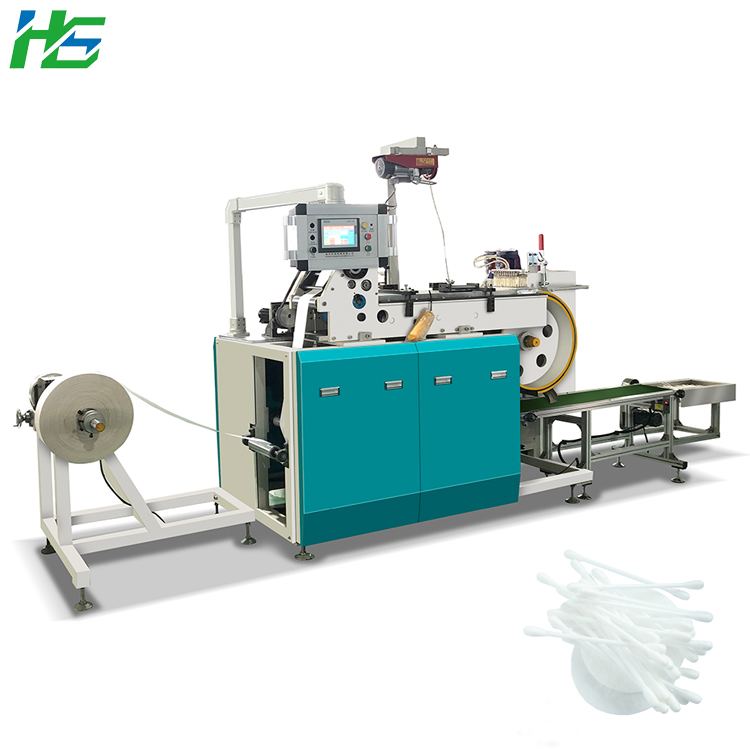
Different end-products require entirely different rolling technologies. Plant managers must understand the mechanical distinctions between straight and skew roll architectures before purchasing equipment.
Comparison: Straight Roll vs. Skew Roll Technologies | ||
Feature | Straight Roll Technology | Skew (Oblique) Roll Technology |
|---|---|---|
Best Diameter Range | 2.5mm – 6.0mm | 1.5mm – 3.5mm |
Core Mechanism | Cuts and forms simultaneously inline | Compresses paper diagonally for density |
Ideal Applications | Beverage stirrers, thick craft poles | Cotton swabs, high-density lollipops |
Key Advantage | Smaller overall footprint, rapid speed | Superior hardness and structural integrity |
Modern manufacturing plants increasingly shift away from pure mechanical drives toward servo-driven, PLC-controlled systems. These modern controllers allow for instant memory saving of diverse batch parameters. They provide auto-fault detection, alerting operators before major jams occur on the line. Upgrading to servo systems significantly reduces raw material waste during morning startups or product changeovers. Mechanical linkages simply cannot offer the dynamic tension adjustments needed for varying paper grades.
Environmental sensitivities play a massive role in factory output. Adhesive performance remains highly vulnerable to plant humidity and ambient temperature fluctuations. Cold facilities often struggle with glue viscosity. Therefore, your machines must feature reliable glue heating and mixing systems to stabilize performance year-round.
The historical weakness of paper stick formation is feed jamming at the paper web. Look for systems featuring automated tension controllers. They manage varying kraft paper roll qualities seamlessly, adjusting braking force dynamically as the roll diameter decreases. Integrating a complete paper stick production line means managing these variables upstream before they cause downstream faults. Sudden tension spikes will snap the paper web, causing costly downtime.
Transparent suppliers mandate strict preventative maintenance schedules. For example, operators must apply calcium grease to heavy load gears bi-weekly. Calcium grease resists ambient moisture better than lithium alternatives. This discipline maintains theoretical production speeds without causing premature wear on the rubber belts or rotary cutting blades. Ignoring lubrication schedules directly degrades cutting precision, resulting in frayed stick ends and rejected batches.
Purchasing a paper forming system is an exercise in managing complex physical variables. A machine optimized for thick lollipop sticks will likely fail at economically producing high-speed, zero-glue cotton swabs. You must align your technical specifications directly with your product's end-use case.
Before moving forward, teams should take the following actionable next steps:
Quantify your exact required diameter ranges and acceptable length tolerances.
Define your specific paper weight, grade, and long-term sourcing strategy.
Demand equipment suppliers run physical sample batches using your specific raw materials.
Evaluate the physical results for hardness, precise length, and adhesive integrity before issuing an RFQ.
A: Guideline: 2.5mm diameter sticks typically require ~70g paper, while thicker 4.0mm+ sticks require 80g+ kraft or coated paper to maintain rigidity.
A: Formula: Volume × specific gravity coefficient (approx. 0.0011 for compacted paper) yields the single stick weight. Multiply by paper and glue costs to establish baseline unit economics.
A: Reality Check: While diameter adjustments are technically possible (often requiring tooling changes), the extreme hardness required for lollipops (often using skew rolls) vs. the high-speed, thin-diameter needs of swabs means dedicating specific machines to specific lines is much more viable for commercial scale.


