
T: +86-18066442232
E: sylvia@wzhongshuojixie.com
E: sylvia@wzhongshuojixie.com
Wanquan Industrial Zone, west of National Road 104, Sunlou Village, Wanquan Town, Pingyang County, Wenzhou City, Zhejiang Province
Views: 0 Author: Site Editor Publish Time: 2026-05-06 Origin: Site


The global push for sustainability has transformed the food service industry. Brands are aggressively shifting away from plastic containers toward eco-friendly alternatives. This rapid transition creates a significant challenge for packaging manufacturers today. You must scale production volume aggressively. At the same time, you cannot compromise seal integrity or hygiene compliance. Excessive raw material waste also threatens your profit margins when substandard equipment fails.
This guide clearly defines the mechanical architecture of a paper food box making machine. We will compare core drive technologies side-by-side. You will explore various sealing methods and substrate compatibilities. By the end, you will gain an evidence-based framework. You can use it to evaluate, shortlist, and procure the exact equipment needed for your specific B2B production lines.
Capacity vs. Complexity: Machine selection hinges on drive systems—mechanical cams offer cost-effective standardized output, while independent servo-driven systems allow for high-speed, complex multi-compartment setups.
Material & Sealing Realities: Sealing technology (hot press, water-based glue, hot-melt) must be precisely matched to the substrate (Kraft, PLA/PE-coated, sugarcane pulp) to prevent structural failure.
Mechanical Integrity Over Specs: High nominal speeds matter less than continuous yield rates; features like robotic arm transfers and integrated mold bases reduce the reject rates common in cheaper free-fall mechanisms.
We define this equipment as an automated food packaging machine. It converts pre-printed and die-cut paper blanks into three-dimensional, leak-proof containers. It achieves this transformation through a highly synchronized, multi-stage process. Understanding this workflow helps you identify potential bottlenecks in your factory.
The sequential manufacturing process relies on precise timing. Here is a step-by-step breakdown of how the machine operates:
Blank Feeding: The process begins at the hopper. Pneumatic suction cups or mechanical feeders draw individual flat paper blanks into the machine. Reliable feeding prevents double-sheet jams.
Gluing/Heating Station: The machine prepares the blank for sealing. It applies targeted adhesives directly to the flaps. Alternatively, it pre-heats PE/PLA coatings to activate their natural bonding properties.
Forming Unit: A specialized male-female mold system physically forces the blank into a specific geometric shape. It folds the side flaps at precise cronicity angles. These angles typically range from 5° to 40°, allowing the final boxes to stack easily.
Ejection & Collection: A mechanical pusher forces the finished containers through the mold. The system collects them, stacks them neatly, and automatically counts them for final packing.
Mistakes at any stage cascade down the line. A slight misalignment during feeding often results in a crushed box at the forming unit.
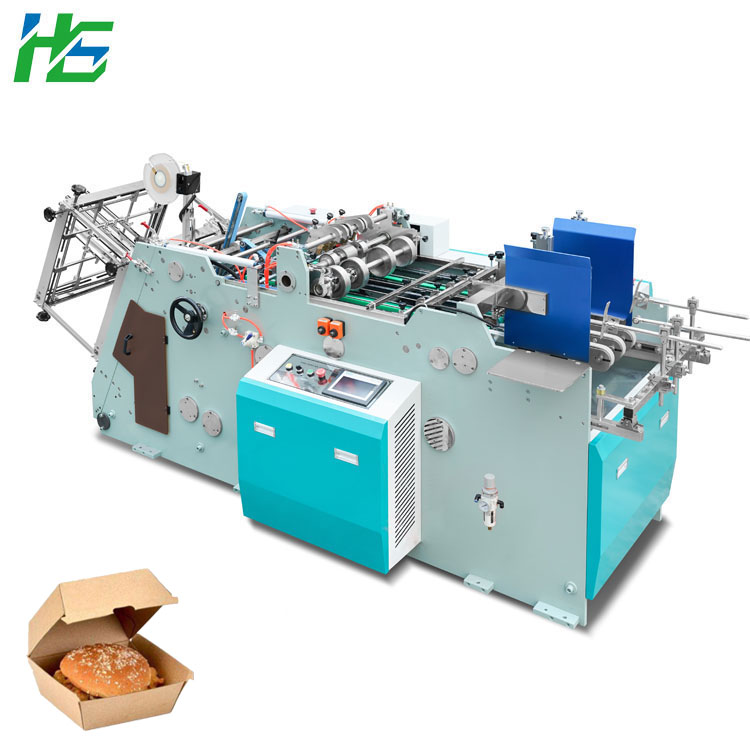
Machine selection heavily depends on the underlying drive architecture. You must choose between traditional mechanical linkages and modern servo motors.
Mechanical machines use traditional cam-and-lever linkages to synchronize movement. They operate at a slower pace, typically producing 30 to 45 pieces per minute. However, they offer distinct advantages. They consume significantly less electrical energy. They do not require compressed air to function. They also present a much lower initial capital expenditure for buyers.
These machines are best for startups. They excel in single-lane production environments focused on standard, uniform shapes. If you rarely need rapid mold changes, a mechanical cam-driven setup provides reliable, cost-effective output.
Servo-driven platforms represent the modern standard for high-volume manufacturing. This technology utilizes independent actuator control for feeding, cutting, and forming. It replaces rigid mechanical cams with programmable logic controllers (PLCs). A single-lane servo machine can output 50 to 400 pieces per minute. Double-lane configurations can push output up to 800 pieces per minute.
The business outcome is substantial. Independent servos reduce mechanical friction and lower overall downtime. The system enables rapid, software-assisted mold changes. You can easily switch configurations to manufacture custom or complex box geometries.
We can summarize the differences in the comparison table below:
Feature | Mechanical Cam-Driven | Servo-Driven Platform |
|---|---|---|
Production Speed | 30 – 45 pcs/min | 50 – 800 pcs/min |
Control Mechanism | Rigid physical cams and levers | Independent actuators and PLCs |
Mold Change Time | 6 to 8 hours (full shift) | 1 to 2 hours |
Ideal Application | Uniform, standard box shapes | Complex geometries, multi-compartment |
Your sealing technology must perfectly match your chosen paper substrate. A mismatch causes structural failures and leaks.
Hot sealing relies on localized heat to melt protective coatings. High-end machines often feature Swiss-style heaters for precise temperature control. The heat melts the PE or PLA coatings, fusing the paper fibers together instantly. This mechanism creates standard water-resistant and grease-resistant takeout boxes. It requires coated paper to function properly.
Water-based glue systems utilize a cold application method. They are highly environmentally friendly. However, they require strict drying parameters to ensure a strong bond. We find this application ideal for exceptionally thick paperboards ranging from 200gsm to 600gsm. Servo-driven lines focusing on high eco-compliance often rely on water-based cold glue.
Hot melt adhesive provides rapid bonding and fast drying times. You need this mechanism for specialty papers. Uncoated or heavily textured Kraft papers resist traditional thermal pressing. Thermal pressing often fails to hold sharp corner folds on these materials. Hot melt ensures rigid, secure corners regardless of the paper texture.
Different food products demand entirely different structural packaging designs. You cannot produce a massive soup bucket on a machine designed for small takeout cartons.
A dedicated hamburger box machine focuses entirely on high-speed, uniform output. It typically produces 4x4 inch boxes. These containers feature simple interlocking fold structures. The machine prioritizes rapid cycling and continuous reliability over complex mold flexibility.
Meal prep services need versatile sizing. A standard paper lunch box machine handles varied dimensions effortlessly. It supports sizes from 5x5 to 8x8 inches. It also accommodates specialized multi-compartment molds. These compartments are critical. They prevent cross-contamination of flavors and liquids during transit.
Tamper-evidence matters for premium delivery brands. A clamshell box machine builds secure, hinged containers. This equipment requires precise die-cutting alignment. It also needs flawless folding mechanisms. If the fold misaligns by a millimeter, the tamper-evident locking mechanism will fail.
Large containers present unique physical stresses. Machines designed for noodle boxes (12-32oz) or massive food buckets (85-170oz) require robust engineering. They utilize heavier gear transmissions. They also feature specialized bottom-punching and bottom-curling stations. These stations maintain structural integrity. The container must support significant weight and heat without collapsing.
Evaluating machine quality requires looking past top-line speed metrics. You must examine the internal components dictating continuous uptime.
Transfer Mechanisms: Always evaluate how the machine moves paper internally. Premium machines use robotic arm transfers. These arms catch, flip, and elevate the blanks. Cheap machines use free-fall gravity drops. Gravity drops drastically increase jam rates and material waste.
Structural Stability: Look for integrated mold bases. Prioritize box-type frame designs. Avoid bolted-together frames. Box-type designs resist the micro-vibrations generated during 24/7 continuous production. Bolted frames slowly vibrate apart, causing alignment drift and poor seals.
Drive Durability: Prioritize gear transmission systems over traditional chain drives. Chains stretch over time. Gears provide heavy-duty, long-term operational accuracy. They ensure perfect timing between the feeding and forming stations.
Lubrication Systems: Automated, quantitative oiling systems are a strict requirement. They eliminate human error. They deliver precise oil amounts to specific bearings. This reduces maintenance overhead and prevents disastrous operator neglect.
Procuring industrial machinery internationally involves complex logistics. A strong B2B contract protects your investment during transit and installation.
Pre-Shipment & Packaging Realities: Sea freight exposes equipment to extreme moisture. Ensure your contracts stipulate heavy-duty anti-rust oil treatments. Demand desiccant inclusions. Mandate marine-grade wooden casing. These steps prevent catastrophic moisture damage during transcontinental shipping.
Installation & Training Logistics: Always clarify vendor support structures beforehand. Unless you use a local authorized agent, standard industry practice dictates buyer responsibilities. The buyer typically covers round-trip flights and accommodation. You must also pay a daily per diem (approximately $100/day) for dispatched installation engineers.
Payment & Warranty Terms: Standard payment structures involve 30% T/T upfront. You pay the remaining 70% before shipment. Letters of Credit (L/C) are standard for orders exceeding $30,000. Finally, demand a minimum 12-month warranty on all core mechanical components.
Investing in a paper food container machine is a strategic decision. It is less about finding the highest stated speed. Instead, it is about matching drive architecture and sealing methods to your specific substrate and volume requirements. Servo-driven machines offer incredible flexibility for complex shapes. Mechanical cams remain highly efficient for standard, uniform runs.
Before contacting a manufacturer, take clear action steps. Calculate your current factory reject rates. Standardize your target blank dimensions and paper weights. Next, request a thorough factory acceptance test (FAT) and an ROI projection based on your exact container geometry.
A: Most commercial machines process board weights between 200gsm and 400gsm. This range covers standard fast food packaging. Specialized heavy-duty servo machines can push limits up to 600gsm for large food buckets and reinforced containers.
A: On traditional mechanical machines, changing a mold takes a full shift of 6 to 8 hours. On modern independent actuator servo-machines, technicians can execute tooling changes rapidly. You can swap setups in just 1 to 2 hours.
A: No. Square folding boxes and round cylindrical containers require fundamentally different mechanical forming processes. Boxes rely on folding and gluing. Bowls require bottom punching and edge curling. You need separate dedicated machinery for each shape type.


