
T: +86-18066442232
E: sylvia@wzhongshuojixie.com
E: sylvia@wzhongshuojixie.com
Wanquan Industrial Zone, west of National Road 104, Sunlou Village, Wanquan Town, Pingyang County, Wenzhou City, Zhejiang Province
Views: 0 Author: Site Editor Publish Time: 2026-05-23 Origin: Site


Transitioning from manual or semi-automated cutting to a highly integrated production line changes everything. You leave behind slow workflows and embrace sheer manufacturing speed. However, choosing the right material feeding mechanism remains a serious challenge. You must decide between a continuous web-fed process and a discrete sheet-fed operation. This choice dictates your floor layout and your long-term operational success.
You face constant pressure to optimize production. Material handling strategies heavily influence your daily efficiency. The wrong choice creates permanent bottlenecks. This guide breaks down the operational realities between roll-fed and sheet-fed die cutting systems. We will explore hidden constraints, output efficiencies, and tooling factors.
We highlight specific material limits and precision variances. You get actionable insights to guide your next major equipment purchase. You will learn how to match equipment capabilities directly with your actual production data.
Volume dictates the feed: A roll to sheet die cutting machine offers superior ROI for high-volume, single-format runs by eliminating manual material handling and enabling inline processing.
Flexibility favors sheets: Sheet-fed systems remain the standard for low-to-medium runs, frequent job changeovers, and rigid or ultra-thick substrates.
Hidden costs matter: The decision extends beyond machine price; buyers must calculate tooling longevity (OEM vs. aftermarket blades), setup waste, and the labor required for continuous feeding.
Precision variations: While both achieve high tolerances, high-speed roll systems require careful web tension control to prevent minor drift, whereas sheet-fed flatbeds excel at deep, uniform creasing for premium packaging.
A roll to sheet die cutting machine pulls material from a continuous web. It feeds the substrate through rotary or flatbed die stations seamlessly. The machine outputs fully stripped, discrete sheets or blanks. This architecture integrates unwinding, cutting, and stacking into a single fluid motion. You do not need secondary handling between steps. The web remains under constant tension. This tension control prevents material buckling during the cutting phase.
This approach relies on pre-cut sheets. Operators load these sheets into a manual or automated feeder. The machine processes one discrete unit at a time. It uses a stop-and-go registration system. Gripper bars pull the sheet into the cutting station. The system stamps the material, releases it, and ejects the finished blank. You must handle the raw material multiple times before the final product emerges.
Sheet-fed machines inherently possess brief idle times between sheet grips. These micro-pauses accumulate over an eight-hour shift. Roll-fed systems eliminate empty motion entirely. They maintain a continuous cutting action. This fundamentally alters the baseline for theoretical maximum output. You must account for these mechanical differences when projecting daily capacities.
Common Mistake: Many buyers assume maximum machine speed equals actual throughput. They ignore the idle time inherent in discrete sheet feeding. Always measure net output per shift rather than theoretical cycles per minute.
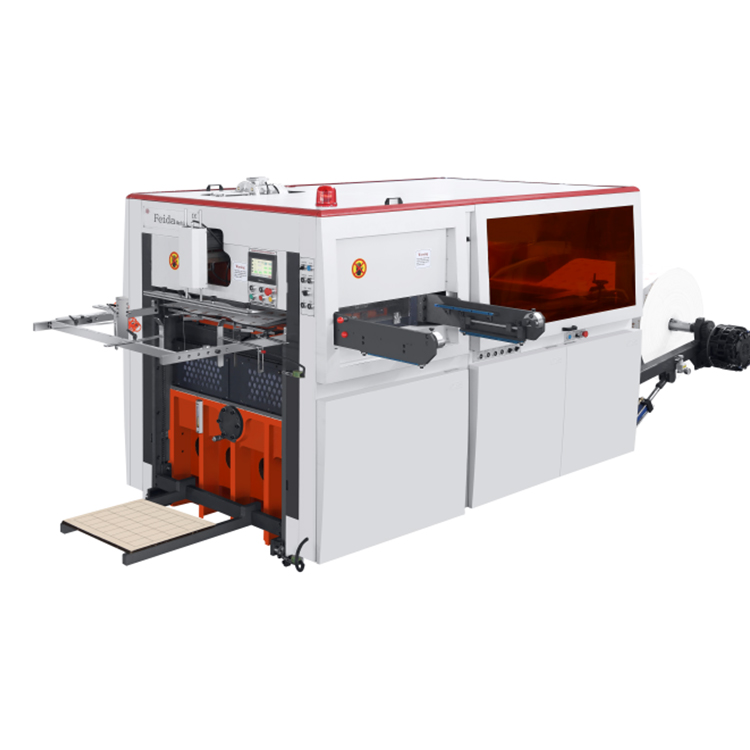
Roll-fed architectures support set-and-forget operation. A single operator can manage multiple machines simultaneously. They load a master roll, dial in the tension, and monitor the output stack. This significantly reduces the labor cost per unit. Current manufacturing labor shortages make this a critical factor. You need automation to maintain profitability. Reducing the human element also lowers the risk of workplace injuries associated with heavy lifting.
Web-fed machines naturally accommodate multiple steps. You can easily add inline flexo printing before the cutting station. Laminating units integrate flawlessly into the web path. Kiss-cutting works beautifully before the final sheeting stage. You combine up to four separate operations into one continuous pass. This consolidation shrinks your required floor space. It also eliminates the need to store work-in-progress inventory between production phases.
Look at standard paper blank cutting for a clear comparison. A continuous roll-fed system outpaces a sheet-fed equivalent easily. You typically see two to three times higher raw output. Master rolls feed much faster than individual sheets. The sheer physics of continuous motion favor the rotary cylinder. We see this advantage compound dramatically during long-run orders.
Automated sheet feeders require constant monitoring. Warped materials cause severe jams. Statically charged sheets stick together. The machine pulls multiple sheets at once when this happens. Operators must intervene frequently to clear faults. You lose valuable production time during these interruptions. Humidity changes inside your facility exacerbate these feeding issues.
Roll-fed systems excel at processing thin, flexible materials. These substrates typically measure under 1/8 inch thick. Excellent examples include paperboard, labels, and barrier films. Medical tapes also spool perfectly onto master cores. The continuous web handles these lightweight materials without wrinkling. However, forcing rigid materials through a rotary nip roller will crack them.
Sheet-fed systems are mandatory for thick corrugated boards. They process dense foams and heavy-duty polycarbonates effortlessly. You cannot spool these rigid materials onto a core. Attempting to roll a thick corrugated board crushes its internal flutes. You must feed these heavy substrates as discrete, flat units.
Sheet-fed flatbeds provide superior vertical stamping pressure. This direct force ensures perfectly clean angles. The system delivers uniform crease depths across the entire sheet. Flatbeds often hold strict ±0.5 mm tolerances. Premium retail packaging demands this exact precision. A clean crease prevents folding carton glue flaps from failing down the line.
Roll systems certainly deliver high precision die cutting under proper conditions. However, maximum speeds introduce new variables. Operators must carefully manage web tension. Minor substrate drift happens naturally during high-speed runs. This lateral drift sometimes stretches tolerances to ±1.0 mm. You must utilize advanced web guides to combat this.
Best Practice: Always test your specific substrate on both systems. Tension control mechanisms vary wildly between equipment manufacturers. Advanced servo-driven nip rollers minimize drift on modern web-fed machines.
Rotary dies used in roll-fed setups demand high initial capital. You pay a premium for precision-machined solid steel cylinders. However, they offer exceptional longevity. These dies often run millions of cycles before requiring sharpening. They represent a long-term manufacturing asset.
Sheet-fed flatbed systems use steel-rule dies. Manufacturers embed bent steel blades into wood or phenolic boards. These tools cost very little. You can produce them incredibly fast. They serve perfectly for short runs and prototyping. Sadly, they wear out much faster. High-pressure stamping degrades the blade edges quickly.
You must evaluate your specific substrate carefully. Cutting abrasive materials degrades blades aggressively. Thick PVC and siliconized liners ruin aftermarket steel blades in days. You should upgrade to OEM carbide blades for these tough jobs. They cost significantly more upfront. They drastically reduce machine downtime by holding their edge longer.
Roll-to-sheet machines allow tighter nesting of parts. You squeeze product footprints closer together along the web. This reduces edge waste significantly over long runs. However, threading the web during initial setup generates scrap. You waste several yards of material pulling it through the machine. Testing a single sheet on a flatbed generates far less initial scrap.
Evaluation Metric | Continuous Roll-Fed | Discrete Sheet-Fed |
|---|---|---|
Tooling Lifespan | Millions of cycles (Solid Rotary) | Lower lifespan (Steel-Rule) |
Setup Scrap Rate | Higher (Web threading required) | Lower (Single sheet testing) |
Long-Run Edge Waste | Minimal (Optimal nesting) | Moderate (Requires gripper margins) |
Maintenance Priority | Tension sensors, nip rollers | Feeder belts, gripper bars |
Your facility focuses heavily on high-volume, repeatable orders. You manufacture standard food packaging or continuous label runs daily. Your raw material supplier offers volume discounts for purchasing master rolls instead of pre-sheeted pallets. You prioritize reducing your labor headcount per shift. You want to integrate printing and cutting into a single automated line.
Your business model relies on high-mix, low-volume orders. You face frequent die changeovers throughout the day. You process heavy corrugated stock, rigid plastics, or specialized finishes. These rigid materials cannot bend around a master core. You require the absolute tightest tolerances for complex, deep-creased structural packaging. You need a reliable packaging die cutter to handle ultra-premium retail finishes.
Do not simply compare equipment specification sheets. You must evaluate the partner behind the machinery. We recommend assessing vendors using these criteria:
Local Dealer Support: Demand transparency on service dispatch times. Machine downtime kills profitability quickly.
Preventative Maintenance: Review the required maintenance schedules. Ensure your internal team can handle the daily lubrication and sensor cleaning tasks.
Software Compatibility: Check the machine's software for job queuing. Modern facilities require seamless integration between the ERP system and the cutting floor.
The choice between a roll fed die cutting machine and a sheet-fed system is not a debate over which technology is superior. It is a decision about which technology aligns with your specific production economics. High-volume operations manufacturing thin, flexible components will see rapid ROI through the automation of roll-to-sheet systems. Conversely, job shops and premium packaging providers handling rigid substrates will rely on the versatility and low tooling costs of sheet-fed units.
Audit your last 12 months of job tickets. Categorize your orders by substrate thickness and average run length. Determine whether changeover frequency or raw throughput acts as your true operational bottleneck. Consult with equipment manufacturers to run physical trials using your most difficult materials. Let empirical data drive your final procurement decision.
A: Yes. Roll-fed systems, particularly those utilizing rotary die stations, are exceptionally capable of kiss-cutting (cutting through the face material while leaving the backing liner intact). This requires precise anvil gap control.
A: If the paper stock is lightweight and the order volume is high, a roll-to-sheet machine is far more cost-effective because it eliminates the premium paid for pre-cut sheets and reduces material handling.
A: Abrasive materials, recycled boards with high particulate content, and heavy plastics degrade steel rules quickly. If cutting these on a sheet-fed flatbed, expect frequent re-ruling. For roll-fed systems, solid tooled rotary dies will handle these better but require expensive factory resharpening when they eventually dull.
A: Slick materials can cause slipping in basic friction-feed systems. Ensure the machine you select (whether roll or sheet-fed) utilizes positive-grip nip rollers, vacuum belts, or tractor feeds to maintain perfect registration.


