T: +86-18066442232
E: sylvia@wzhongshuojixie.com
E: sylvia@wzhongshuojixie.com
Wanquan Industrial Zone, west of National Road 104, Sunlou Village, Wanquan Town, Pingyang County, Wenzhou City, Zhejiang Province
Views: 0 Author: Site Editor Publish Time: 2026-07-30 Origin: Site


Investing in a packaging line remains a high-stakes capital expenditure for any business. Choose the wrong hardware, and you risk daily production bottlenecks. You might also waste valuable factory floor space on inefficient setups. Many buyers fall into a very common trap during procurement. They focus entirely on the maximum rated speed printed in glossy brochures. Unfortunately, this ignores realistic operational yields. It overlooks tedious changeover times and strict material limits. We see manufacturing operations struggle constantly because of this oversight. Their equipment looks fantastic on paper but fails under real-world shifts. This guide cuts through the loud marketing noise. We break down the exact technical metrics you need to evaluate. You will learn how to align machine capabilities with actual production demands. We also cover critical compliance standards and long-term return on investment. By mastering these parameters, you ensure success. Your next manufacturing asset will drive profitability rather than cause endless maintenance headaches.
Peak mechanical speed simply tells you how fast belts and gears can physically move. It rarely reflects the actual number of boxes hitting your shipping pallet. We call the real, actionable number your operational yield. Yield accounts for inevitable paper jams and adhesive refills. It also factors in operator loading times and routine cleaning pauses. Always ask manufacturers for yield data based on your specific box design. A machine rated for 300 boxes per minute might only net 220 in reality. For instance, if your operators need five minutes to load a new paper roll every hour, your actual throughput drops significantly. You must plan your production schedules around this net figure.
You should carefully consider when to upgrade your line layout. Investing in a dual-station production paper box making machine makes perfect sense for high-volume, standardized runs. It effectively doubles your output within a similar operational timeframe. However, the implementation reality requires extreme caution from plant managers. Dual-station setups demand highly robust inline material handling systems. Without fast upstream feeding and rapid downstream stacking, you simply move the bottleneck somewhere else. We often see facilities install dual-station units only to watch them sit idle. Their operators simply cannot load blank sheets fast enough to keep up.
You must rigorously assess the stamina of your equipment. Is the hardware officially rated for continuous 24/7 industrial production? Or does it safely max out at 8-hour single-shift operations? Check the motor duty cycles and bearing lifespans carefully. Scaling businesses absolutely need continuous-duty ratings to handle rapid growth. Heavy-duty machines utilize reinforced steel frames and oversized bearings. These absorb the intense vibrations generated during round-the-clock operations. Lighter machines might use aluminum components. These warp under constant thermal stress. Undersized motors overheat quickly during peak seasonal demands. When motors overheat, safety sensors trigger automatic shutdowns. These shutdowns cost you valuable hours during your busiest seasons.
GSM stands for Grams per Square Meter. Along with caliper ratings, these dictate exactly what paperboard you can run safely. These are strictly non-negotiable paper box making machine specifications. If you force 400 GSM board through a unit rated for 250 GSM, belts will snap. Drive bearings will wear out prematurely. Conversely, running flimsy 150 GSM paper through heavy-duty rollers causes immediate crumpling. Many buyers make the mistake of buying equipment based solely on current needs. If you plan to expand into premium packaging next year, you need a machine supporting higher caliper boards today. Ensure the feeder mechanisms adjust smoothly to accommodate both thin kraft paper and dense recycled boards.
You cannot treat all packaging styles the same. Different markets require vastly different mechanical approaches. Rigid boxes demand precise corner pasting and flawless wrapping mechanics. Tolerances here must remain incredibly tight to avoid visible seams. Luxury brands reject packaging showing even minor glue stains. Corrugated shipping boxes demand highly aggressive feeding belts instead. Flute compatibility is vital for smooth operations. Heavy-duty crush rollers handle thicker E-flute or B-flute boards. The folding sections must apply massive pressure to crease thick corrugated layers correctly.
Consider the booming market for takeaway food packaging. Here, the hardware needs high sanitary wash-down ratings for daily cleaning. A standard paper box making machine might struggle processing specialized food-grade materials. The unit must handle non-toxic adhesives flawlessly. It must also process complex moisture-barrier coatings without jamming the feeder tracks.
Always verify the exact dimensional envelope. Measure length, width, and height limitations rigorously. You must ensure the hardware handles your largest and smallest projected SKUs. Push the limits too far, and registration accuracy drops significantly. Small boxes often skew sideways if the belt spacing cannot narrow sufficiently. Oversized boxes might clip the safety guards during high-speed rotation.
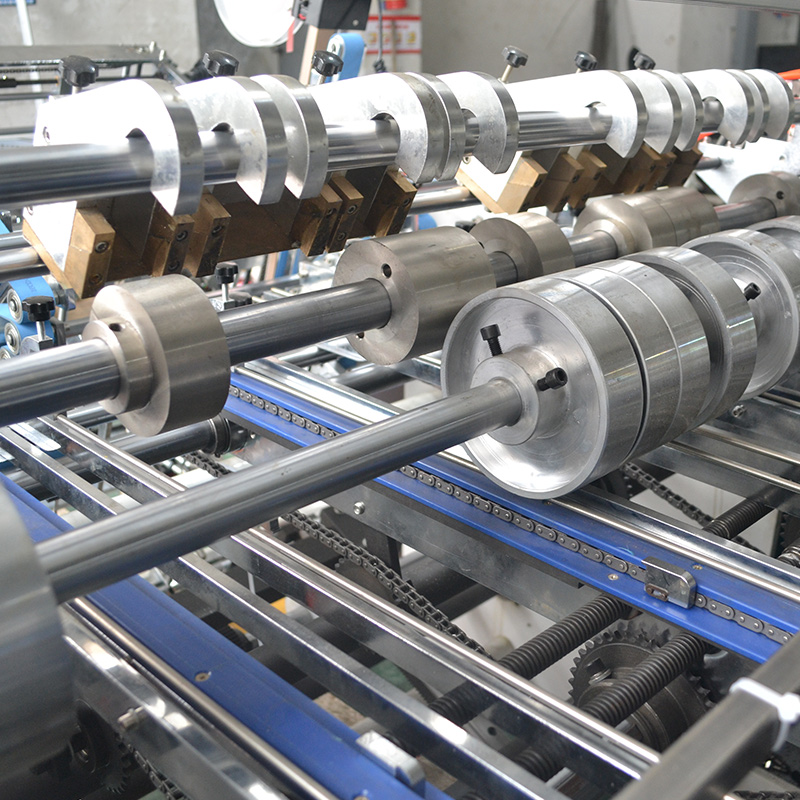
Switching between box sizes eats directly into valuable production hours. Traditional tooled changeovers require operators to manually unbolt and adjust guide rails. This process easily wastes several hours per shift. Consider a facility processing ten different box sizes daily. If a tooled changeover takes forty minutes, you lose over six hours of production time just adjusting rails. Tool-less changeovers use motorized servo adjustments instead. They reduce setup times from hours to mere minutes. Operators select a pre-saved recipe on the touch screen. The belts auto-adjust instantly. This agility is a critical metric for short-run packaging lines.
Sometimes standard off-the-shelf models fall short of unique client demands. Evaluating a custom paper box making machine requires checking its underlying modularity. Can you easily add inline window patching later? What about attaching specialized gluing stations for crash-lock bottom boxes? Modular designs let you scale capabilities as your client demands evolve. You avoid buying an entirely new line when industry trends change.
Automation completely reshapes your workforce dynamics. You must plan for these operational shifts:
Full automation never eliminates labor costs entirely. It simply changes the type of labor you need to hire. This is a transparent assumption every buyer must make. Maintenance staff must understand complex PLCs and multi-axis servo drives. They keep highly automated lines running efficiently. You trade brute physical force for advanced technical oversight.
Quality assurance directly impacts your overall profitability. Look for equipment featuring highly integrated optical sensors. Missed glue detection systems and optical alignment checkers reduce scrap rates dramatically. Catching a misaligned fold instantly prevents thousands of ruined blanks. High-speed ejectors can kick out defective boxes without stopping the entire line. This keeps your operational yield high while actively protecting your brand reputation.
You must evaluate your physical footprint against available factory space. Do not forget power consumption and pneumatic requirements. Air pressure needs often catch buyers completely off guard. Underpowered compressors lead to sluggish pneumatic cylinders. Sluggish cylinders cause misaligned glue flaps and rejected batches.
Compare standard setup footprints to avoid factory floor crowding:
| Configuration Type | Average Footprint (L x W) | Power Consumption | Pneumatic Capacity |
|---|---|---|---|
| Single-Station Compact | 4m x 2m | 10-15 kW/h | Standard Air (6 bar) |
| Dual-Station Industrial | 8m x 3m | 25-40 kW/h | High-Capacity Compressor |
| Fully Modular Custom Line | 12m x 4m | 45+ kW/h | Dedicated Air Circuit |
Mandatory CE or ISO certifications prove the equipment meets authoritative manufacturing standards. Ensure the machine features accessible emergency stop integrations. Proper safety guarding around high-speed belts prevents severe workplace injuries. These features are absolutely crucial for passing rigorous factory safety audits. They also protect your operators from fatigue-related accidents during long night shifts.
Brilliant mechanical engineering means nothing without strong factory backing. Technical specs require a reliable support infrastructure. You must deeply trust your paper box making machine supplier to keep you operational. A breakdown during peak holiday seasons can cost thousands in lost revenue. Partnering with responsive engineers ensures you recover quickly.
Focus on what happens after installation. Evaluate these critical post-sale specifications:
We recommend mapping your primary product materials and sizes first. Do this before looking at equipment catalogs. Next, define your required daily volume to gauge throughput accurately. Calculate your available factory space and power limits carefully. Finally, deeply assess supplier credibility and service records before signing any contracts. Following this logical framework prevents expensive mismatch errors and ensures smooth integration.
Never buy industrial equipment blindly. We strongly encourage buyers to request a live material test. Send your specific paperboard and CAD designs to shortlisted vendors. Watch them run your actual product on video. Verify the fold accuracy and glue adhesion before negotiating final pricing. Taking this extra step guarantees the hardware matches your unique operational reality.
A: It typically ranges from ±1mm to ±2mm. This depends heavily on the machine’s alignment technology and the quality of the incoming paperboard. Optical sensors help maintain tighter tolerances during high-speed production runs. Poorly die-cut blanks will always reduce final gluing accuracy regardless of machine quality.
A: A dual-station setup generally requires 30% to 50% more linear footprint than standard single-station models. You must also account for extra perimeter clearance. Operators need wide aisles for raw material staging and finished pallet removal. Forklift turning radius should dictate your final layout decisions.
A: Rarely. Forming mechanisms and pressure tolerances differ significantly between these materials. Rigid boxes demand precise wrapping and pasting around thick chipboard. Corrugated cartons require heavy-duty folding and gluing. Buyers generally need dedicated equipment for each specific packaging application to ensure consistent quality.